

- About the Department
- Vision and Mission and PEOs
- Head of Department
- Programme Specific Outcome (PSO)SyllabusFaculty Committees ListEvents
- Laboratories
About the Department
The department is one of the pioneer department since the commencement of the C. G. Patel Institute of Technology in 2009. The department has well qualified and fully dedicated faculty members engaged in teaching with the aim of achieving excellence in various fields. The Department actively promotes curriculum development activity by updating existing courses, developing new courses and preparing resource material for teaching. Industry Interaction and academic exchanges with emphasis on R&D are an integral characteristic of our department. The department offers the Diploma in Civil Engineering, Under Graduate program B.Tech in Civil Engineering and Post Graduate program M.Tech in Structural Engineering, Soil Mechanics and Foundation Engineering and Environmental Engineering. Apart from these, the department also offers Doctoral program in Civil Engineering.
Vision
To be recognized as a prominent center of excellence in Civil Engineering, renowned for outcome-based and innovative education that fosters ethically strong professionals, sustainable technological advancements, and transformative contributions to meet the dynamic needs of global society.
Mission
1.Foster Fundamental Excellence: To instill strong fundamental concepts, analytical capabilities, and problem-solving skills in students, equipping them with technical proficiency for sustainable Civil Engineering solutions through holistic, experiential, and outcome-based learning
2.Drive Research and Innovation: To cultivate innovative research,
entrepreneurship, and technological advancement by imparting technical and management skills, forging industry linkages, and establishing the department as a reliable knowledge resource for academia, industry, and society.
3. Nurture Ethical Leadership: To develop morally and ethically strong engineers who are responsive to environmental changes and global dynamics, serving as knowledgeable leaders contributing to national development and societal betterment.
PEOs
PEO1: Graduates will excel as proficient Civil Engineers, applying fundamental knowledge and problem-solving skills to design sustainable infrastructure solutions.
PEO2: Graduates will engage in research, innovation, and entrepreneurship, contributing to technological advancements and industry-relevant projects.
PEO3: Graduates will demonstrate ethical leadership, environmental responsibility, and lifelong learning to address global societal challenges.
Head of Department
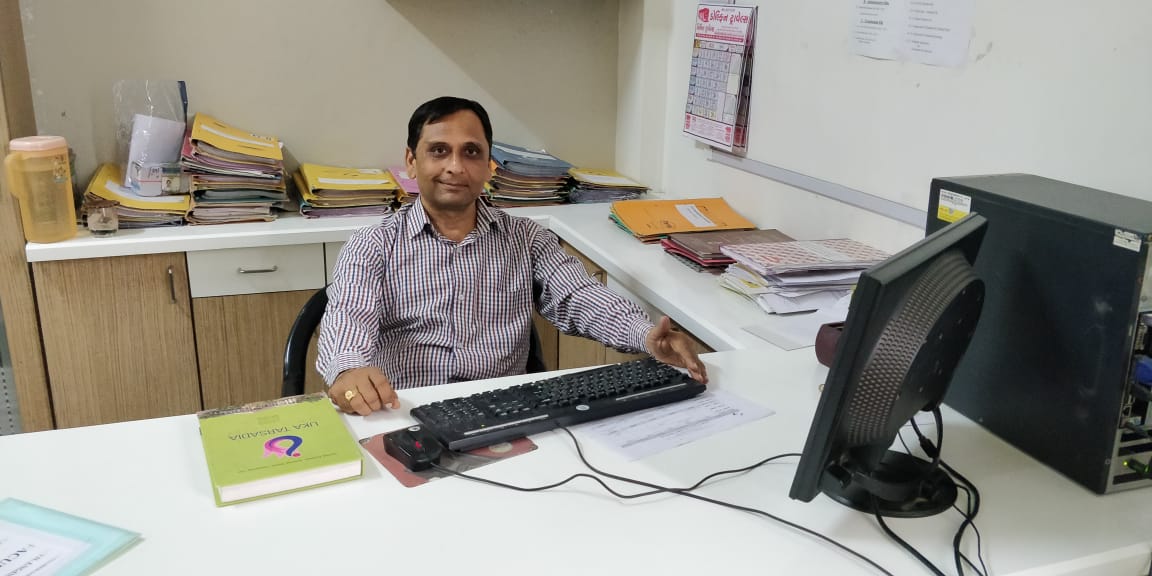
Dr. Manoj Gundalia
HoD, Civil Department, CGPIT.
+91-9909461142
manoj[dot]gundalia[at]utu[dot]ac[dot]in
Message for Students
Dear Students,
I take the privilege to welcome you all to the Department of Civil Engineering. The department of Civil Engineering at C. G. Patel Institute of Technology has an excellent infrastructure and state-of-art labs with a teaching faculty of the best kind ensuring quality education. The aim of the department is to impart the students a sound knowledge of the theory of civil engineering subjects with exposure to practical knowledge through laboratories and field study.
Civil engineering is the second-oldest engineering discipline after military engineering and it is a professional engineering discipline that deals with the design, construction and maintenance of physically built works like roads, bridges, canals, dams and buildings.There are many career paths for civil engineers. Civil engineers are essential in government agencies, private and public sector undertakings to take up various mega projects like metro railway projects, express highway corridors, industrial structures, reservoir projects, flyovers, townships and mega city projects. Today, the world is undergoing vast changes in technological revolution, population growth and environmental concerns. All these changes create unique challenges for civil engineers.
The program through its activities is committed to ensuring that our students are ready to meet the different challenges of tomorrow!
B.Tech Civil Engineering
After successful completion of programme graduate will able to:
PSO1: Apply principles of Civil Engineering to propose application-centric solutions utilizing modern tools and techniques.
PSO2: Plan, design, and construct sustainable infrastructures satisfying economic, environmental, social, ethical, and safety constraints.
PSO3: Communicate effectively with stakeholders and add value to multidisciplinary domains in addition to Civil Engineering.
Knowledge and Attitude Profile (WK)
WK1: A systematic, theory-based understanding of the natural sciences applicable to the discipline and awareness of relevant social sciences.
WK2: Conceptually-based mathematics, numerical analysis, data analysis, statistics and formal aspects of computer and information science to support detailed analysis and modelling applicable to the discipline.
WK3: A systematic, theory-based formulation of engineering fundamentals required in the engineering discipline.
WK4: Engineering specialist knowledge that provides theoretical frameworks and bodies of knowledge for the accepted practice areas in the engineering discipline; much is at the forefront of the discipline.
WK5: Knowledge, including efficient resource use, environmental impacts, whole-life cost, re-use of resources, net zero carbon, and similar concepts, that supports engineering design and operations in a practice area.
WK6: Knowledge of engineering practice (technology) in the practice areas in the engineering discipline.
WK7: Knowledge of the role of engineering in society and identified issues in engineering practice in the discipline, such as the professional responsibility of an engineer to public safety and sustainable development.
WK8: Engagement with selected knowledge in the current research literature of the discipline, awareness of the power of critical thinking and creative approaches to evaluate emerging issues.
WK9: Ethics, inclusive behavior and conduct. Knowledge of professional ethics,
responsibilities, and norms of engineering practice. Awareness of the need for diversity by reason of ethnicity, gender, age, physical ability etc. with mutual understanding and respect, and of inclusive attitudes.