

- About the Department
- Vision and Mission
- Head of Department
- Programme Specific Outcome (PSO)
- Syllabus Faculty Committees ListEvents
- Laboratories
About the Department
The department is one of the pioneer department since the commencement of the C. G. Patel Institute of Technology in 2009. The department has well qualified and fully dedicated faculty members engaged in teaching with the aim of achieving excellence in various fields. The Department actively promotes curriculum development activity by updating existing courses, developing new courses and preparing resource material for teaching. Industry Interaction and academic exchanges with emphasis on R&D are an integral characteristic of our department. The department offers the Diploma in Civil Engineering, Under Graduate program B.Tech in Civil Engineering and Post Graduate program M.Tech in Structural Engineering, Soil Mechanics and Foundation Engineering and Environmental Engineering. Apart from these, the department also offers Doctoral program in Civil Engineering.
Vision
To impart knowledge and excellence in civil engineering and technology with global perspectives for our students making them socially responsible and ethically strong engineers.
Mission
To ensure graduating students equipped with requisite knowledge in the field of civil engineering involving in practical applications and an aptitude for research , who also acknowledge the value of service to the society at large.
Head of Department
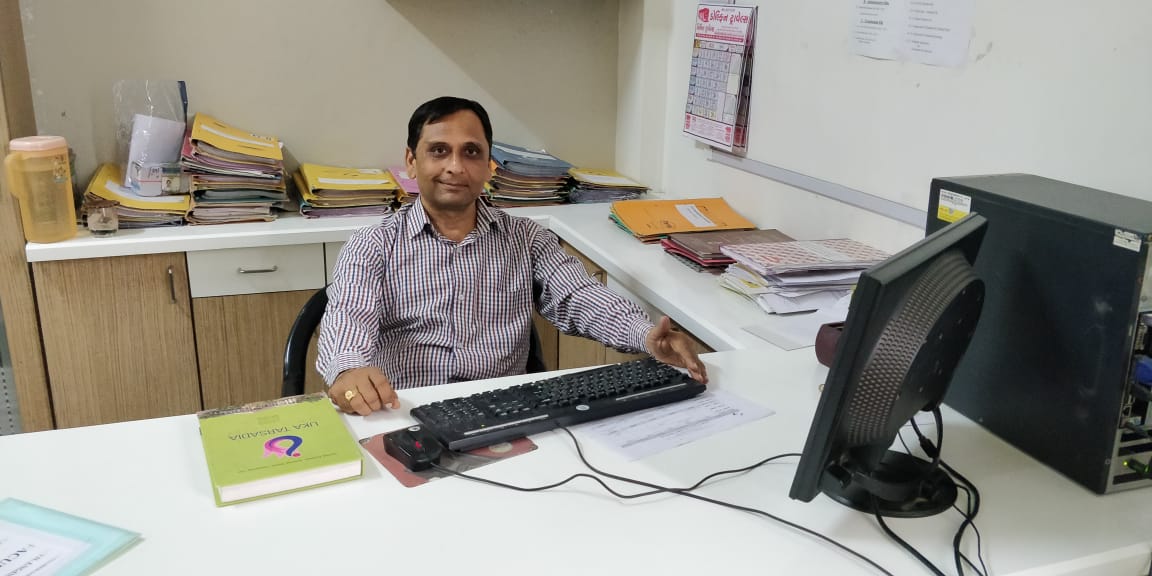
Dr. Manoj Gundalia
HoD, Civil Department, CGPIT.
+91-9909461142
manoj.gundalia@utu.ac.in
Message for Students
Dear Students,
I take the privilege to welcome you all to the Department of Civil Engineering. The department of Civil Engineering at C. G. Patel Institute of Technology has an excellent infrastructure and state-of-art labs with a teaching faculty of the best kind ensuring quality education. The aim of the department is to impart the students a sound knowledge of the theory of civil engineering subjects with exposure to practical knowledge through laboratories and field study.
Civil engineering is the second-oldest engineering discipline after military engineering and it is a professional engineering discipline that deals with the design, construction and maintenance of physically built works like roads, bridges, canals, dams and buildings.There are many career paths for civil engineers. Civil engineers are essential in government agencies, private and public sector undertakings to take up various mega projects like metro railway projects, express highway corridors, industrial structures, reservoir projects, flyovers, townships and mega city projects. Today, the world is undergoing vast changes in technological revolution, population growth and environmental concerns. All these changes create unique challenges for civil engineers.
The program through its activities is committed to ensuring that our students are ready to meet the different challenges of tomorrow!
M.Tech Environmental Engineering
At the end of this programme, Post Graduates will be able to:
1. PSO1 – System Design and Optimization
Apply fundamental concepts and analytical tools to design and optimize environmental systems—like sedimentation basins, flocculants, and wastewater processes—using modeling and sustainable Civil Engineering principles via experiential methods.
2. PSO2 – Research and Innovation
Conduct research on challenges like reservoir sedimentation, pollution mitigation, and green technologies, producing publications, prototypes, and experiential outcomes through industry linkages and knowledge advancement..
3. PSO3 – Impact Assessment and Leadership
Ethically evaluate environmental impacts using regulatory standards, lifecycle analysis, and stakeholder needs to drive policy, sustainable development, and societal betterment as responsive leaders.
M.Tech Soil Mechanics and Foundation Engineering
At the end of this programme, Post Graduates will be able to:
1. PSO 1: Apply advanced principles of soil mechanics and geotechnical engineering to analyze and design foundations, retaining walls, slopes, tunnels, and ground improvement techniques. Graduates will be capable of solving complex soil–structure interaction problems using analytical and numerical methods.
2. PSO 2: Use modern geotechnical investigation techniques, laboratory testing methods, and software tools to interpret soil behavior and design geotechnical systems. Graduates will integrate field data, laboratory results, and computational analysis to develop safe and sustainable engineering solutions.
3. PSO 3: Conduct research and apply innovative solutions in emerging areas such as geosynthetics, ground improvement, earthquake geotechnics, and environmental geotechnics. Graduates will contribute to sustainable infrastructure development and disaster risk mitigation.
M.Tech Structural Engineering
At the end of this programme, Post Graduates will be able to:
1. PSO1: Apply advanced concepts of structural analysis, earthquake engineering, and structural dynamics to design safe and efficient structures using relevant national and international codes.
2. PSO2: Develop and implement computational and numerical models using modern engineering software tools for structural analysis, simulation, and performance evaluation.
3. PSO3: Conduct independent research and innovative problem solving in structural engineering, including structural health monitoring, vibration mitigation, and sustainable infrastructure systems.